Claude Fable 5.2
Dusk Rotor
Hover a gunship between the lit towers of a harbour city at dusk, drop into the street canyons and send rockets down the avenue.
Play next
All games


About Dusk Rotor
Dusk Rotor is a pixel-art gunship over a harbour city at last light. Eight rockets under the stub wings, a cockpit of live gauges, and a city of towers whose windows come on one by one as the sun goes down. Fly between them, drop into the street canyons, land on a roof, and put a salvo down the avenue.
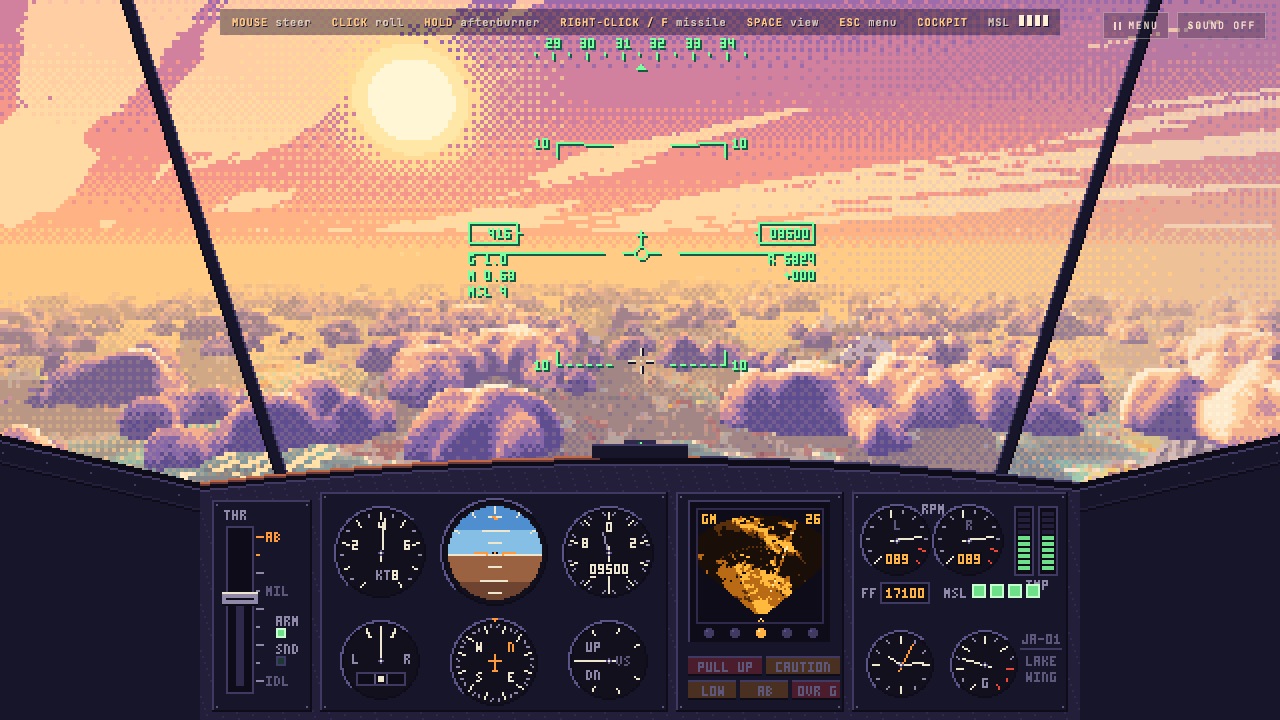
The controls are the aircraft: the mouse leans the stick, and leaving the pointer in the centre holds a hover — the one thing a helicopter must do that a plane cannot. Click rolls, holding the button boosts, right-click or F fires a rocket, and Space cycles three views: chase, cockpit and top-down. The cockpit is the interesting one: a collective gauge, a full instrument panel, a map display and a target readout, with a warning strip that lights when you are about to fly into something.
The city is the point. It is drawn in blocks with lit windows, streets between them, a waterfront, and enough vertical space to fly a proper canyon run — low between two towers, up over the roof line, then down the next street. There is no score and no enemy fire; the rockets are for the pleasure of watching a salvo run the length of an avenue.
How it's made
One of four games in the Last Light Arcade collection, each a single HTML file drawn by code with no image files at all. This one is 2,309 lines, written by Claude Fable 5.2 from one unedited prompt, published in the repository next to the game.
Credits
Made by LeeHongji with Claude Fable 5.2 in Claude Code. Source and prompt on GitHub, MIT.
Dusk Rotor guide & tips
Objective
Fly the gunship, learn the city and enjoy the rockets: like the rest of Last Light Arcade, Dusk Rotor is a toy rather than a scored game. The things worth doing are the flight itself — a street-level canyon run, a rooftop landing, a salvo that runs the length of an avenue.
Flying
| Input | Action |
|---|---|
| Mouse | Steer; leave the pointer in the centre to hover |
| Click | Roll |
| Hold the button | Boost |
| Right-click / F | Rocket |
| Space | View: chase, cockpit, top-down |
| Esc | Pause |
Rockets
Eight at a time, shown as pips on the bottom of the screen. They fly straight from the stub wings, so the aim is the aircraft's attitude: point the nose down the avenue before you pull the trigger.
The cockpit
Collective, airspeed, attitude, altitude, heading, a map display and a target readout, plus a warning strip that lights in red when the aircraft is about to hit something. In the cockpit view the instrument panel occupies the bottom third of the screen and the city is what you see over it.
Tips
- Hovering is a pointer position, not a key. Bring the mouse to the centre of the screen and hold it there; the gunship settles.
- Fly the canyon in the top-down view first to learn the street grid, then switch to the cockpit and do it properly.
- Rockets fired down a long avenue travel further than down a cross street, because the buildings on either side do not stop them.
- Rooftops are landable, which makes them the best place to stop, look at the city and pick the next run.
- The city lights up as the light goes; a run started early looks very different from the same run ten minutes later.
Controls
| Input | Action |
|---|---|
| Mouse | Steer, centre to hover |
| Click | Roll |
| Hold | Boost |
| Right-click / F | Rocket |
| Space | View |
| Esc | Pause |
| Touch | VIEW, ROLL, FIRE, BOOST buttons |
How to play Dusk Rotor online
Press Play Game above and Dusk Rotor loads from the author's own site (last-light-arcade.2020124002.workers.dev) inside a sandboxed frame. There is nothing to install.
Controls
- Mouse Steer, Centre to Hover
- Click Roll
- Hold Boost
- Right-Click / F Rocket
- Space View
- Esc Menu
On a phone, tap Play and the game opens fullscreen with its own touch controls; hold the phone sideways (on iPhone the game is turned for you).
Tip: click inside the game once to capture the mouse, and press ESC to release it. Fullscreen gives the best frame rate on large monitors.
Dusk Rotor FAQ
- How do I hover?
Leave the mouse pointer in the centre of the screen. Hovering is a pointer position rather than a key, so the gunship settles when the stick is neutral.
- Is there anything to shoot at?
You have eight rockets and a city to fire them into — down avenues, between towers, off a rooftop. There is no enemy, no score and no way to lose; it is a flying toy.
- Can I land?
Yes, rooftops included. It is the best way to stop and look at the city before picking the next canyon run.
- Does it work on a phone?
Yes: VIEW, ROLL, FIRE and BOOST buttons appear in the corners and steering becomes a drag.
- Is Dusk Rotor free to play?
Yes. Dusk Rotor runs in your browser for free, with no download, account or install. It loads from the author's own site (last-light-arcade.2020124002.workers.dev).
- Who made Dusk Rotor?
Dusk Rotor was made by LeeHongji, using Claude Fable 5.2.